Ankylosing Spondylitis Research & Resources
The Autoimmune Connection
Ankylosing Spondylitis is an Autoimmune Disease which causes an inflammatory arthritic disorder of multiple parts of the human body including but not limited to joint pain, skeletal fusion and chronic lower back pain. It is also associated eye conditions like uveitis and iritis; as well as having an association with certain  gastrointestinal disorders like IBD, Crohns, Gastritis and Ulcerative Colitis.
This condition seems to be more prevalent in those people who are tested positive for a genetic marker called HLA-B27. I believe there may also be a connection to the Rh-Negative incompatibility in humans. This theory is based on the research that 85+% of individuals diagnosed with Ankylosing Spondylitis or "AS"; happen to test positive for the HLA-B27 genetic marker, which is said to be had by only about 8% of the population or less, based on geographical location. I saw a connection because the blood type O- also appears in about 7% of the population and again that percentage varies by the same geographical location of the population. After researching this connection and family history, I felt confidant enough to lay out my theory for my mothers' doctors, they listened and tested her for the genetic marker and it came back positive.
I do not know what the connection is; but I am looking, researching and trying to find the answers. In the meantime, I am learning about symptoms, treatments, effects and more. I will share with you what I find. Together, hopefully we can find the answers to improve the human condition. Click the link to join the forum or to learn more about other associated conditions, please click here!
 | Find out how HLA-B27 is involved in many of the Autoimmune Conditions. Figure out what conditions you could be at risk for and the associated diseases that you may one day face. Get the facts and connections you need to educate your family or assist your health care professional to understand the entirety of your condition. Information, video's, statistics, research studies and more; all related to Autism, Amyloidosis, Marfan's Disease and connected to the Rh-Negative Factor and HLA-B27 and other associated gene markers. |
Wikipedia Definition:
Ankylosing spondylitis – (AS, from Greek ankylos, bent; spondylos, vertebrae), previously known as Bekhterev's disease, Bekhterev syndrome, and Marie-Strümpell disease, a form of Spondyloarthritis, is a chronic, inflammatory arthritis and autoimmune disease. It mainly affects joints in the spine and the sacroilium in the pelvis, and can cause eventual fusion of the spine. It is a member of the group of the spondyloarthropathies with a strong genetic predisposition. Complete fusion results in a complete rigidity of the spine, a condition known as bamboo spine.
Spondylitis Association of America Definition:
Ankylosing spondylitis – (AS): An inflammatory arthritic disorder, primarily of the axial skeleton (sacroiliac joints and spine), but can affect hip and shoulder joints and infrequently the peripheral joints. It causes chronic back pain and leads to stiffness of the spine. Most of the affected individuals have the HLA-B27 gene.
(RhNegative UPDATE! Two genetic markers newly identified as, associated with Ankylosing Spondylitis; they are ARTS1 and IL23R.)
Other Definitions:
Ankylosing spondylitis – An inflammatory arthritis affecting mainly back joints, can be associated with inflammation in tendons ligaments.
Ankylosing spondylitis – A chronic form of spondylitis primarily in males,marked by impaired mobility of the spine; may leads to ankylosis.
Ankylosing spondylitis – A particular arthritis disease that affects usually the joints between vertebrae and the sacroiliac joint.
Ankylosing spondylitis – Arthritis of the spine, resembling rheumatoid arthritis.
The following list of drugs, medications, treatments and therapies associated and used with the
treatment of Ankylosing Spondylitis is meant for your personal research and reference only.
The information on this website should NOT be used as a substitute or without the expertise,
knowledge and judgement of your healthcare providers.
Tumor Necrosis Factor (TNF) Inhibitors, Immunosuppressants,
Antirheumatics & Monoclonal Antibodies
Cox-2 Inhibitors
Generic Name: Celecoxib
Glucocorticoids
Generic: Triamcinolone Generic: Prednisone Generic: Dexamethasone Generic: Dexamethasone Generic: Triamcinolone
NSAIDs & Anti-Inflammatories
Platelet Aggregation Inhibitors & Salicylates
Generic Name: Aspirin
If you're taking a medication, treatment or therapy that is
NOT on this list, please ADD IT by clicking HERE!
RECALL ALERT: Methotrexate
Rheumatoid Arthritis Medication
Oct. 28, 2010 -- Glass flakes have led to the recall of Sandoz and Parenta brand injectable methotrexate, a drug used to treat rheumatoid arthritis, cancer and psoriasis.
Click Here for more Information.
|

Blood Tests
Early Detection
Education
Genetic Testing
Good Posture
Regular Doctor Visits
Regular Exercise
Vitamin Balancing
The Descriptive DiagnosisAnkylosing Spondylitis can also cause inflammation, pain and stiffness in other areas of the body such as the shoulders, hips, ribs, heels and small joints of the hands and feet. Skin issues can be symptomatic and eye issues can also be involved, this is known as Iritis or Uveitis. Sometimes internal organs including the lungs and heart can also be affected. With ankylosing spondylitis, it is normal to see involvement of the sacroiliac (SI) joints during the progression of the autoimmune disease. Sacroiliac Joints are the joints at the base of the spine, where the spine joins the pelvis.
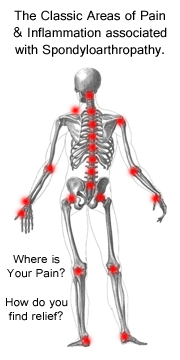
A physical examine will include looking for sites of pain, swelling, inflammation or disfigurement of the joints. Most physicians will check for pain and tenderness along the back, pelvic bones, sacroiliac joints, chest and heels, as well as for any limitations of your spinal mobility in any directions. They may also check for any restriction of chest expansion or trouble breathing. A history or family history of iritis or uveitis (a painful inflammation of the eye or eyes), any gastrointestinal infections or issues, Crohn's Disease, IBS, ulcerative colitis, diagnosed Ankylosing Spondylitis (AS), and fatigue with inflammation my be other symptoms and/or indicators that may be taken into diagnostic consideration. | The Physical ExamSome symptoms taken into account for an "AS" diagnosis are:
|
Is There a Cure for Ankylosing Spondylitis?
There is NO known cure for AS at this time. There are however treatments, medications and therapies available to reduce the symptoms, manage the pain and slow the progression of damage. New medical studies give hope that the new biologic medications may be able to slow or halt the disease progression in some patients.
Diabetes | COPD | Depression | Planter Fasciitis | Carpel Tunnel |
Uveitis | Iritis | High blood pressure | Ulcerative Colitis | Tendinitis in elbows |
Osteoporosis | Gastritis | Underactive thyroid | Knee Pain | Knee Replacement |
Hiatus hernia | Depression | Elbow Pain | Recurring Anemia | Diminished Sex Drive |
Wrists Hurt | Hands swell | Joints pop real easy | Spine pop real easy | Headaches |
Tired all the time | Lower Back Pain | Heals burn at night | Achilles Tendon Pain | Numbness in hands |
Skin Sores | Skin Rashes | Hyper pigmentation | Virtigo | Peroneal Nerve Damage/drop foot |
Cervical Fusion | Ankle Fusion | Lumbar Fusion | Psoriatic Arthritis | Crusty spots on scalp and face |
Colitis | Heel Spur | Shoulder Surgeries | Reactive Arthritis | Removal of Spinal Hardware Overgrowth |
Extremities burning | Extremities hurt | Extremities Feel Asleep | Extremities Stinging | Arthroscopic knee procedures |
Stomach issues | Crohn's | Eye/Vision Issues | Get Very swollen | Bump on Back/Side of Neck |
Fatigue | IBS | Weak Extremities | Disfigured Joints | Shoulder Polyarthritis |
Over all sick feeling | Glaucoma | Palindromic Rheumatism | Pain in hips and back | Cramping feeling all over |
Painful Joints | Cataracts | Trouble holding down food | Psoriasis | Multifocal Chroiditis (rare) |
Anxieties | Hair loss | Reproductive Health Issues | Tendinitis | Adrenal Surressant Disease |
Ankylosing Spondylitis can occasionally lead to complications of internal organs, including the heart and lungs. Rarely, some people with AS may develop problems with the heart's aortic valve, this is called Aortic Insufficiency and/or Heart Rhythm Issues. Aortic Insufficiency is a disease of the heart valve in which it either weakens or balloons and prevents the valve from closing tightly. This may lead to the backward flow of blood from the aorta into the left ventricle of the heart.
Aortic insufficiency may result from any condition that causes weakening of the aortic valve. The condition causes dilation or widening of the left lower chamber of the heart. As this area of the heart becomes worse, it is less able to pump blood to the rest of the aorta, and the heart tries to make up for the problem by sending out larger amounts of blood with each heart contraction. Eventually, untreated this may lead to a strong and forceful pulse. In the past, rheumatic fever was the primary cause of aortic insufficiency, until antibiotics started being used to treat rheumatic fever. Currently many other causes are more commonly seen.
Ankylosing Spondylitis may also cause valvular heart disease, specifically
aortic valve and ascending aortic disease. If they are not treated it can cause heart failure, atrial fibrillation and ventricular tachycardia. If the heart valve gets calcified because of Ankylosing Spondylitis and there is a blockage; it can cause the need for use of a pacemaker. Failure in a valve in the left side of the heart or the the aortic or the mitral valve may results in left side heart failure. This leads to an accumulation of fluids in the lungs, or pulmonary edema. Valve diseases of the right side of the heart or the the pulmonary and tricuspid valve while rare, can occur as the result of some forms of congenital heart disease or long-term left-sided heart failure.
Lung Complications including; Pulmonary Fibrosis, Idiopathic Pulmonary Fibrosis or Restrictive Lung Disease may also develop in some patients. Idiopathic fibrosis is a thickening or scarring of the lungs, for which there is currently no known cause. Breathing may become increasingly difficult because of this stiffening. For some people the disease may worsen little over time, for others it can progress quickly over months or years. The condition is believed to result from an inflammatory response to an unknown substance, as the word Idiopathic actually means, "No cause can be found". Most often this disease happens to the elderly from age 50 on, but there can be exceptions to the rule.
At this time there is no known treatment for this disease. So far, Pharmaceutical Drugs have not been shown to improve the patient’s outcome with this disease. Some drugs like Corticosteroids and Cytotoxic Drugs may help to reduce the inflammation. Oxygen may also be necessary in advanced cases. Although lung rehabilitation may help to maintain capacity during activity or exercise, it will not cure the disease. In advanced cases, the final stage may be the need for a lung transplant.
Aortic Insufficiency Symptoms:
- Chest Pain, the angina type
Under the chest bone but may migrate
Sensation of Crushing, Pressure, Tightness or Squeezing
Pain Increases with exercise & decrease with rest.
- Forceful or Pounding pulse
- Fainting
- Fatigue
- Heart Palpitations
- Irregular Racing, Rapid or Fluttering Pulse
- Shortness of breath
- Swelling of the left lower heart chamber, seen by ECG or chest x-ray
- Weakness
Idiopathic Pulmonary Fibrosis Symptoms
- Abnormal breath sounds called crackles
- Abnormal enlargement of the fingernail bases called Clubbing
- Blue-colored skin called Cynosis near mouth of fingernails from low oxygen (In advanced cases).
- Cough (usually dry)
- Decreased ability to participate in activity
- Occasional Chest Pain
- Shortness of breath
- Trouble expanding chest
| Ankylosing Spondylitis seems to occurs in people who carry certain genes and who are exposed to a trigger. Below is a list of "triggers" that are thought to be associated with AS. I have listed all triggers that could be found by name, so it may appear some are duplicated. Click on the individual "Triggers" for more information. |
According to studies and articles from up to 10 years ago, really 10 years ago, the scientific research and medical communities have recognized the association of the HLA-B27 genetic marker and the heightened risk of developing both Leukemia and Lymphoma. I am currently compiling the research, but in the mean time here are links to some studies, findings and other articles.
I promise to make it easier to read through, but the information is too important to delay your access to. More to come!
Risk of Haematological Malignancies in HLA-B27 carriers
Acute myelogenous leukaemia in an adult presenting with uveitis
Rh-Neg Association to Breast Cancer
Blood Type & Cancer Association